Home > Compound List > Compound details
98-59-9 molecular structure
click picture or here to close

4-methylbenzene-1-sulfonyl chloride

ChemBase ID: 70354
Molecular Formular: C7H7ClO2S
Molecular Mass: 190.64728
Monoisotopic Mass: 189.98552814
SMILES and InChIs

SMILES:
c1(ccc(cc1)C)S(=O)(=O)Cl
Canonical SMILES:
Cc1ccc(cc1)S(=O)(=O)Cl
InChI:
InChI=1S/C7H7ClO2S/c1-6-2-4-7(5-3-6)11(8,9)10/h2-5H,1H3
InChIKey:
YYROPELSRYBVMQ-UHFFFAOYSA-N

Cite this record

CBID:70354 http://www.chembase.cn/molecule-70354.html

Collapse All Expand All

NAMES AND DATABASE IDS

NAMES AND DATABASE IDS

Names Database IDs
IUPAC name
4-methylbenzene-1-sulfonyl chloride
IUPAC Traditional name
P-toluenesulfonyl chloride
Synonyms
p-toluenesulfonyl chloride
p-TsCe
TsCl
4-Toluenesulfonyl chloride
4-Methylbenzenesulfonyl chloride
Tosyl chloride
p-TOLUENESULFONYL CHLORIDE
p-Toluenesulfonyl chloride
4-Methylbenzenesulphonyl chloride
4-Methylbenzene-1-sulfonyl chloride
4-Methylbenzenesulfonyl chloride
4-甲苯磺酰氯
对甲苯磺酰氯
CAS Number
98-59-9
EC Number
202-684-8
MDL Number
MFCD00007450
Beilstein Number
607898
Merck Index
149534
PubChem SID
24889256
24889257
24900152
162036074
24854440
PubChem CID
7397
Chemspider ID
7119
Wikipedia Title
4-Toluenesulfonyl_chloride

CALCULATED PROPERTIES

CALCULATED PROPERTIES

JChem
H Acceptors H Donor
LogD (pH = 5.5) 2.4329703  LogD (pH = 7.4) 2.4329703 
Log P 2.4329703  Molar Refractivity 45.2934 cm3
Polarizability 18.15714 Å3 Polar Surface Area 34.14 Å2
Rotatable Bonds Lipinski's Rule of Five true 

PROPERTIES

PROPERTIES

Physical Property Safety Information Product Information Bioassay(PubChem)
Solubility
hydrolysis in water expand Show data source
methylene chloride: soluble0.2 g/mL, clear expand Show data source
Soluble in alcohol, benzene, and ether. Insoluble in water expand Show data source
Apperance
White solid expand Show data source
Melting Point
65-69 °C expand Show data source
65-69 °C(lit.) expand Show data source
66-69 °C expand Show data source
67.4 °C expand Show data source
67.4°C expand Show data source
67-70°C expand Show data source
Boiling Point
134 °C at 10 mmHg expand Show data source
134 °C/10 mmHg(lit.) expand Show data source
134.5 °C at 10 mmHg; 151.6 °C at 20 mmHg expand Show data source
146°C/15mm expand Show data source
Flash Point
128 °C (closed cup) expand Show data source
128 °C expand Show data source
128°C expand Show data source
128°C(262°F) expand Show data source
262.4 °F expand Show data source
Density
1.33 g/ml expand Show data source
1.35 expand Show data source
Vapor Pressure
1 mmHg ( 88 °C) expand Show data source
1 mmHg at 88 °C expand Show data source
Storage Condition
Room Temperature (15-30°C), Desiccate, Store Under Nitrogen expand Show data source
Storage Warning
Corrosive/Moisture Sensitive/Store under Argon expand Show data source
IRRITANT expand Show data source
Moisture Sensitive expand Show data source
RTECS
DB8929000 expand Show data source
European Hazard Symbols
Corrosive Corrosive (C) expand Show data source
Irritant Irritant (Xi) expand Show data source
UN Number
1759 expand Show data source
3261 expand Show data source
UN3261 expand Show data source
MSDS Link
Download expand Show data source
German water hazard class
1 expand Show data source
Hazard Class
8 expand Show data source
Packing Group
2 expand Show data source
II expand Show data source
Australian Hazchem
2X expand Show data source
Risk Statements
34 expand Show data source
38-41 expand Show data source
R:34 expand Show data source
Safety Statements
26-36/37/39-45-60 expand Show data source
26-39 expand Show data source
S:26-27/28-36/37/39-46-64 expand Show data source
EU Classification
C10 expand Show data source
EU Hazard Identification Number
8B expand Show data source
Emergency Response Guidebook(ERG) Number
154 expand Show data source
TSCA Listed
false expand Show data source
expand Show data source
GHS Pictograms
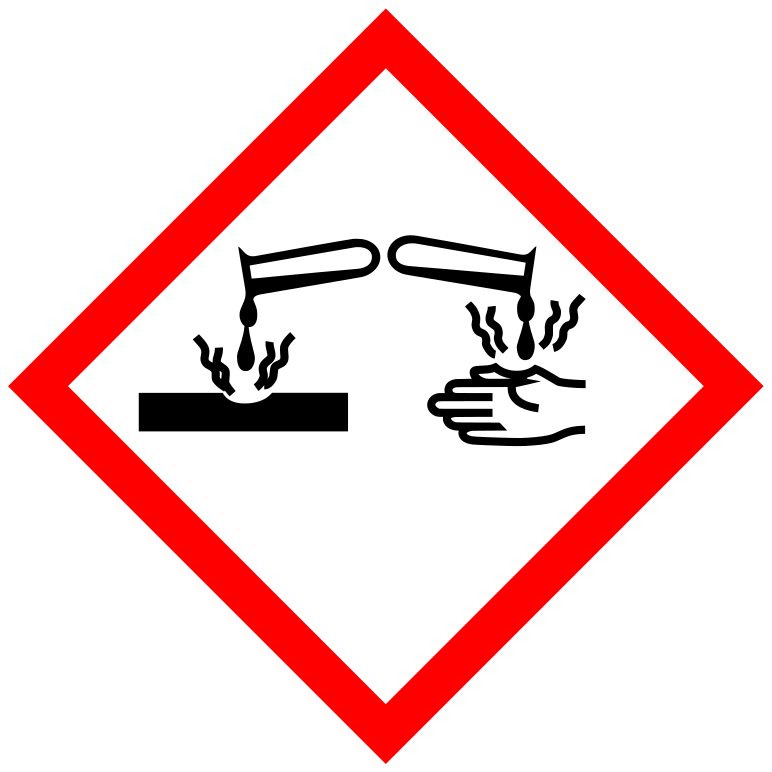
GHS05 expand Show data source
GHS Signal Word
Danger expand Show data source
Main Hazard
releases acid expand Show data source
NFPA704
NFPA 704 diagram
1
3
0
expand Show data source
GHS Hazard statements
H314-H318 expand Show data source
H315-H318 expand Show data source
GHS Precautionary statements
P260-P303+P361+P353-P305+P351+P338-P301+P330+P331-P405-P501A expand Show data source
P280-P305 + P351 + P338 expand Show data source
Personal Protective Equipment
Eyeshields, Faceshields, full-face particle respirator type N100 (US), Gloves, respirator cartridge type N100 (US), type P1 (EN143) respirator filter, type P3 (EN 143) respirator cartridges expand Show data source
RID/ADR
UN 3261 8/PG 2 expand Show data source
Purity
≥97.0% (AT) expand Show data source
≥98% expand Show data source
≥99% expand Show data source
≥99.0% (AT) expand Show data source
95+% expand Show data source
98% expand Show data source
Grade
puriss. expand Show data source
purum expand Show data source
reagent grade expand Show data source
ReagentPlus® expand Show data source
Certificate of Analysis
Download expand Show data source
Linear Formula
CH3C6H4SO2Cl expand Show data source

DETAILS

DETAILS

MP Biomedicals MP Biomedicals Wikipedia Wikipedia Sigma Aldrich Sigma Aldrich
MP Biomedicals - 05218665 external link
MP Biomedicals Rare Chemical collection
MP Biomedicals - 02152653 external link
Crystalline
Sigma Aldrich - T35955 external link
Packaging
1 kg in poly bottle
1 kg packaged in glass bottles; 3 kg packaged in open-head poly drums
3 kg in poly drum
Sigma Aldrich - 240877 external link
Packaging
100 g in poly bottle
5 g in glass bottle
500 g in glass bottle
Legal Information
ReagentPlus is a registered trademark of Sigma-Aldrich Co. LLC

REFERENCES

REFERENCES

From Suppliers Google Scholar IconGoogle Scholar PubMed iconPubMed Google Books IconGoogle Books
  • • For a detailed study of the optimum conditions for the tosylation of primary and secondary alcohols in pyridine, see: J. Org. Chem., 51, 2386 (1986). For use of 1,4-Diazabicyclo[2.2.2]octane, A14003, as an alternative to pyridine in the tosylation of alcohols, see: Synthesis, 1433 (1997). In the presence of a carboxylic acid, the ester is formed in high yield: J. Am. Chem. Soc., 77, 6214 (1955); 79, 2146 (1957). Esterification of an unprotected amino acid can be effected by heating the tosylate salt with tosyl chloride in an alcohol solvent: J. Org. Chem., 48, 121 (1983).
  • • In the presence of strong bases, 1,2-diols can be converted to epoxides: Synthesis, 706 (1977); 983 (1985); Synth. Commun., 23, 285 (1993), and 1,3-diols to oxetanes: Synthesis, 550 (1981).
  • • N-Tosylation has been used to block the imidazole nucleus in histidine: Bull. Chem. Soc. Jpn., 42, 1466 (1969); 47, 3146 (1974), and arginine residues: Experientia, 24, 661 (1968), during peptide synthesis. Cleavage can be effected with HF. See Appendix 6.
  • • Dehydrating agent, e.g. for conversion of ureas to carbodiimides: Org. Synth. Coll., 5, 555 (1973); Synthesis, 520 (1987).
  • Searching...Please wait...

PATENTS

PATENTS

PubChem iconPubChem Patent Google Patent Search IconGoogle Patent

INTERNET

INTERNET

Baidu iconBaidu google iconGoogle